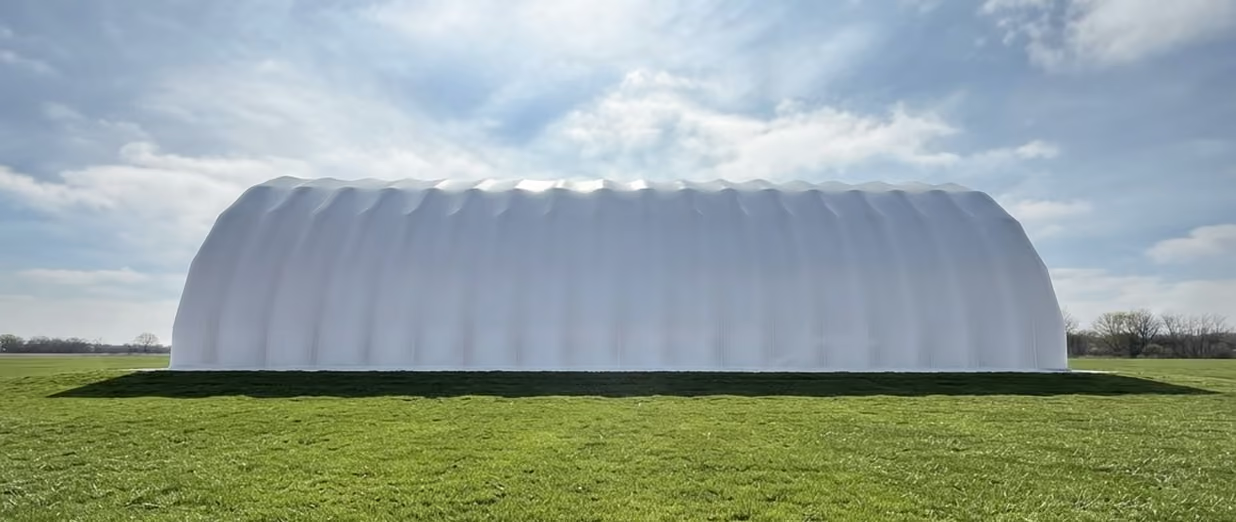
Air Instead of Concrete: What Air-Beam Structures Are and Why They Matter
Imagine a building delivered by truck that transforms into a fully functional hangar, hospital, or exhibition hall in less than a month — no tower crane, no concrete mixer, no months of waiting. This isn't a gimmick or marketing fluff — it's air-beam structures, and the technology has long since moved beyond the experimental stage.
What They Actually Are
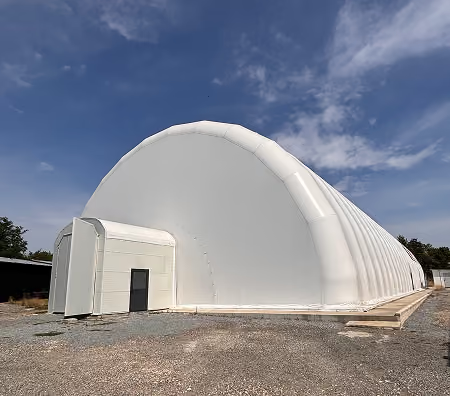
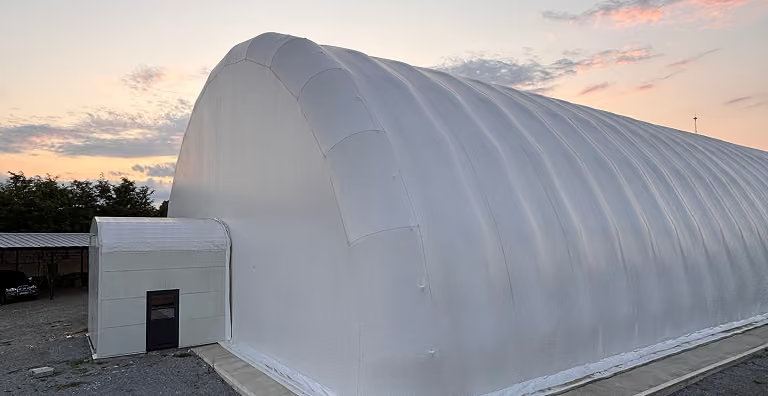
An air-beam structure is a building whose frame isn't made of steel beams or timber trusses, but of sealed air beams — tubes of high-strength technical fabric inflated to high pressure. Each beam carries load on its own, and together they form an arch, a dome, or a rectangular volume, over which an outer membrane skin is stretched.
The key difference from the inflatable tents we're all familiar with is that the pressure inside these beams is 1.04 times the atmospheric pressure. Once inflated, a beam becomes rigid — a genuine structural member, not just a puffed-up bag.
Where They're Used
The range of applications goes well beyond "temporary tent":
Military field hospitals and command posts — the US Army has deployed these shelters in combat zones for decades, since a small team can assemble a full medical unit in a matter of hours
Warehouses, aircraft and equipment hangars, temporary production facilities
Warehouses, aircraft and equipment hangars, temporary production facilitiesASports venues — tennis domes, inflatable "bubble" football pitches, ice rinks
Exhibition halls, concert pavilions, festival stages
Humanitarian aid stations and temporary housing after earthquakes, floods, and other disasters
Quarantine units and mobile laboratories
Agricultural storage and shelter — grain stores, greenhouses, livestock enclosures
Why It's Considered the Newest Word in Rapid Construction
Air-beam technology grew out of decades of military and aerospace composite research, and only in the last twenty years or so has it moved into mainstream civilian construction in earnest. The beams are made from multilayer fabrics related to those used in body armor and parachute rigging, and airtightness and shape are managed not by a crude fan but by a system that inflates each section independently. Compared with the classic inflatable dome familiar from Expo '70, the gap is roughly the one between a flip phone and a smartphone: same basic idea, an entirely different level of engineering.
Advantages Over Air-Supported Structures (A.S.S.)
ASS is the older approach, where the entire building envelope is held up by constant, excess air pressure inside the whole volume — essentially a giant air mattress you live in. Air-beam structures work differently, and that gives them a real edge:
No dependence on continuous fan operation.
In an A.S.S., a power outage means the building starts sagging within minutes. In an air-beam structure, every beam is already inflated and holds its shape on its own.
No airlocks or double-door vestibules.
Air-supported buildings need airlock entries to keep pressure from escaping, which slows down foot traffic. Air-beam structures can have ordinary wide doors.
Localized damage doesn't threaten the whole structure.
If one beam is punctured, it deflates while the rest keep holding up the roof — the building doesn't come down suddenly the way a fast ASS depressurization can.
Lower running costs.
A.S.S. buildings need powerful blowers running constantly; air-beam structures don't.
More stable under wind loads
since rigid arched beams resist deformation better than a single taut membrane.
Advantages Over Other Fast-Build Methods
Compared with modular buildings, tension-fabric hangars, or lightweight steel structures:
Unmatched erection speed.
A structure with an area of hundreds of square meters goes up in 3–21 days, rather than months, and no crane is needed
A fraction of the transport volume.
Folded down, an air-beam structure takes up a small part of the space that modular units or a steel frame would require — critical when a building has to be flown in or trucked to a remote site.
Minimal crew.
Where modular construction needs heavy equipment and several trades, an air-beam structure goes up with a handful of people and a compressor.
No conventional foundation required
anchors or ballast are enough, so it can be set up on snow, sand, asphalt, or uneven ground
Easy to take down and reuse.
Deflate, fold, move to the next site — a cycle that's simply not possible with a steel frame, let alone a modular building.
Natural light and no thermal bridging
a common weak point in metal-framed structures
Notable Real-World Examples
The technology has had its moment on the world stage more than once:
At the 2012 London Olympics, an air-beam structure formed the 33-meter athletes' tunnel that more than 10,000 competitors walked through to enter the stadium during the opening ceremony — engineered to provide weather protection while still breaking down into sections for transport.
For the 2015 Toronto Pan Am/Parapan Am Games, two large air-beam pavilions made up "Ontario's Celebration Zone" on the Toronto waterfront — one held up to 1,500 people with arches reaching 15 meters high, and both structures were fully erected in just 72 hours.
The US Army has relied on AirBeam-based field hospitals for years (the FPE-MS system, for instance) — they deploy far faster than traditional tent hospitals and include sealed airlock entries for protection against chemical and biological threats.
Air-beam technology has also crossed over into aerospace — NASA drew on research from the Army-founded Center of Excellence for Inflatable Composite Structures for inflatable module and antenna projects.
As for the technology's "relatives" — classic air-supported domes like the Minnesota Metrodome, Tokyo Dome, and Carrier Dome — they've demonstrated both the strengths and the weak points of the constant-internal-pressure approach, and those weak points are exactly what air-beam technology was built to fix.